Boston Fern vs Calathea: Which Pet-Safe Plant Is Right for You?
This post contains affiliate links. If you buy through them, I earn a small commission at no extra cost to you. As an Amazon Associate I earn from qualifying purchases.
Boston fern and calathea are two of the most beautiful, most popular, and — importantly — most pet-safe houseplants you can bring home. Both are ASPCA non-toxic to cats and dogs, so the real question is not “is it safe?” but “which one suits your home and your patience level?”
This side-by-side guide breaks down light, water, humidity, and difficulty so you can choose with confidence.
Are both safe for pets?
Yes — and this is verified, not assumed.
The ASPCA lists the Boston fern (Nephrolepis exaltata) as non-toxic to cats and dogs. The ASPCA lists the calathea (family Marantaceae, also sold as prayer plants) as non-toxic to cats, dogs, and horses too.
As always, non-toxic means “not poisonous,” not “meant to be eaten.” A pet that chews a lot of either plant may get a brief upset stomach, but neither contains a dangerous toxin. That makes both safe to place at floor or shelf level in a pet home.
The quick comparison table
| Factor | Boston Fern | Calathea |
|---|---|---|
| Light | Bright, indirect | Medium, indirect (tolerates lower) |
| Humidity | High (50%+) | High (50%+) |
| Water | Keep evenly moist | Keep evenly moist; sensitive to tap water |
| Difficulty | Moderate | Moderate to fussy |
| Look | Full, arching green fronds | Bold patterned, colorful leaves |
| Pet safety | ASPCA non-toxic | ASPCA non-toxic |
Boston fern: the lush classic
The Boston fern is the plant people picture when they think “hanging green fern.” It is a fantastic natural humidifier and, per the ASPCA, completely pet-safe.
Its non-negotiable is moisture — both in the soil and in the air. Standard indoor humidity of 10–15% is far below the 50%+ these plants want, and dry air shows up as brown, crispy leaflets. Keep the soil consistently moist (never bone dry, never waterlogged), give it bright indirect light, and mist or use a pebble tray. Do that and it rewards you with an overflowing, cascading habit that suits a hanging basket or a plant stand.

A classic, fast-filling fern that doubles as a natural humidifier. Pair it with a humid spot — a bright bathroom is ideal — and it’s ASPCA-safe for cats and dogs.
Check price on Amazon →Want the full routine? See the Boston fern care guide.
Calathea: the living artwork
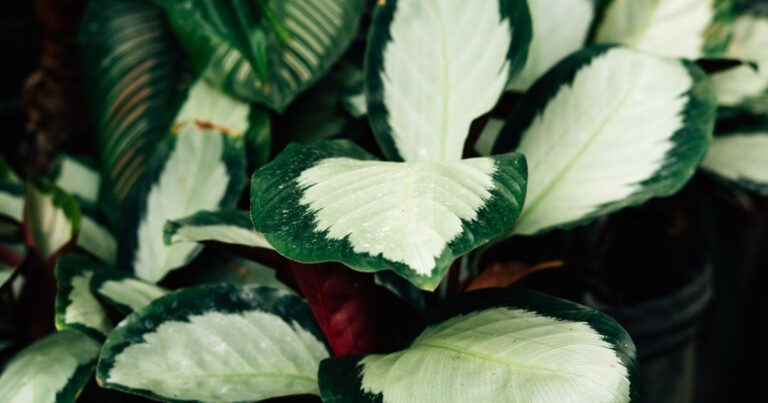
If the Boston fern is about lush volume, the calathea is about drama. Its leaves come in striking patterns — pinstripes, brushstrokes, deep purple undersides — and many varieties famously fold up at night, which is why the wider group is nicknamed “prayer plants.”
Calatheas want medium, indirect light (too much sun fades the pattern), consistently moist soil, and high humidity. Their one quirk: they are sensitive to the minerals and chlorine in tap water, which can brown the leaf edges. Filtered or distilled water, or rainwater, keeps them happiest.
Bold patterned foliage that’s ASPCA non-toxic to cats and dogs. Tip: verify the plant tag — some plants sold as “prayer plant” are actually Maranta or Stromanthe (all pet-safe, but different care).
Check price on Amazon →Full details in the calathea care guide.
Which one should you get?
- Choose the Boston fern if you have a bright, humid spot (or a steamy bathroom), want a big, full, cascading look, and don’t mind regular watering.
- Choose the calathea if you want colorful, patterned foliage, have medium indirect light, and are willing to use filtered water to keep the edges crisp-free.
- Get both if you want a pet-safe humidity-loving duo — they thrive in the same conditions and look great grouped together (grouping also raises local humidity).
Either way, you are covered on the thing that matters most: both are verified safe for cats and dogs.
FAQ
Is Boston fern or calathea safer for cats?
Both are ASPCA non-toxic to cats. Neither is safer than the other on toxicity — they are both fine.
Which is easier to care for?
The Boston fern is usually a touch more forgiving; calatheas can be fussy about water quality and humidity. Neither is truly “beginner-proof,” but both are manageable.
Do I need to worry if my cat nibbles the leaves?
No toxin is involved, so a nibble is not dangerous. Eating a large amount could cause mild, temporary stomach upset, as with any plant.
The bottom line
You cannot go wrong on safety here — the Boston fern and the calathea are both ASPCA-verified non-toxic. Pick based on your light and your tolerance for a little fuss: fern for lush and forgiving, calathea for colorful and characterful.
Keep building your safe collection with the best pet-safe low-light plants and the spider plant care guide. And before you shop, know the toxic houseplants to keep away from pets.
Sources
- ASPCA — Boston Fern (non-toxic to cats and dogs)
- ASPCA — Calathea (non-toxic to cats and dogs)
- ASPCA — Prayer Plant / Maranta (non-toxic)
Written by Mo Ruman, a self-taught plant parent who cross-checks every plant against the ASPCA database. Not a vet — when in doubt, call yours. More about Kijani Paws · Ask me about a plant. As an Amazon Associate, Kijani Paws earns from qualifying purchases; this never affects our safety information.
Get the free pet-safe plant checklist
One email when a new ASPCA-verified guide goes live. No spam, unsubscribe anytime.




2 Comments
Comments are closed.